Sudan: No Peace Without Women
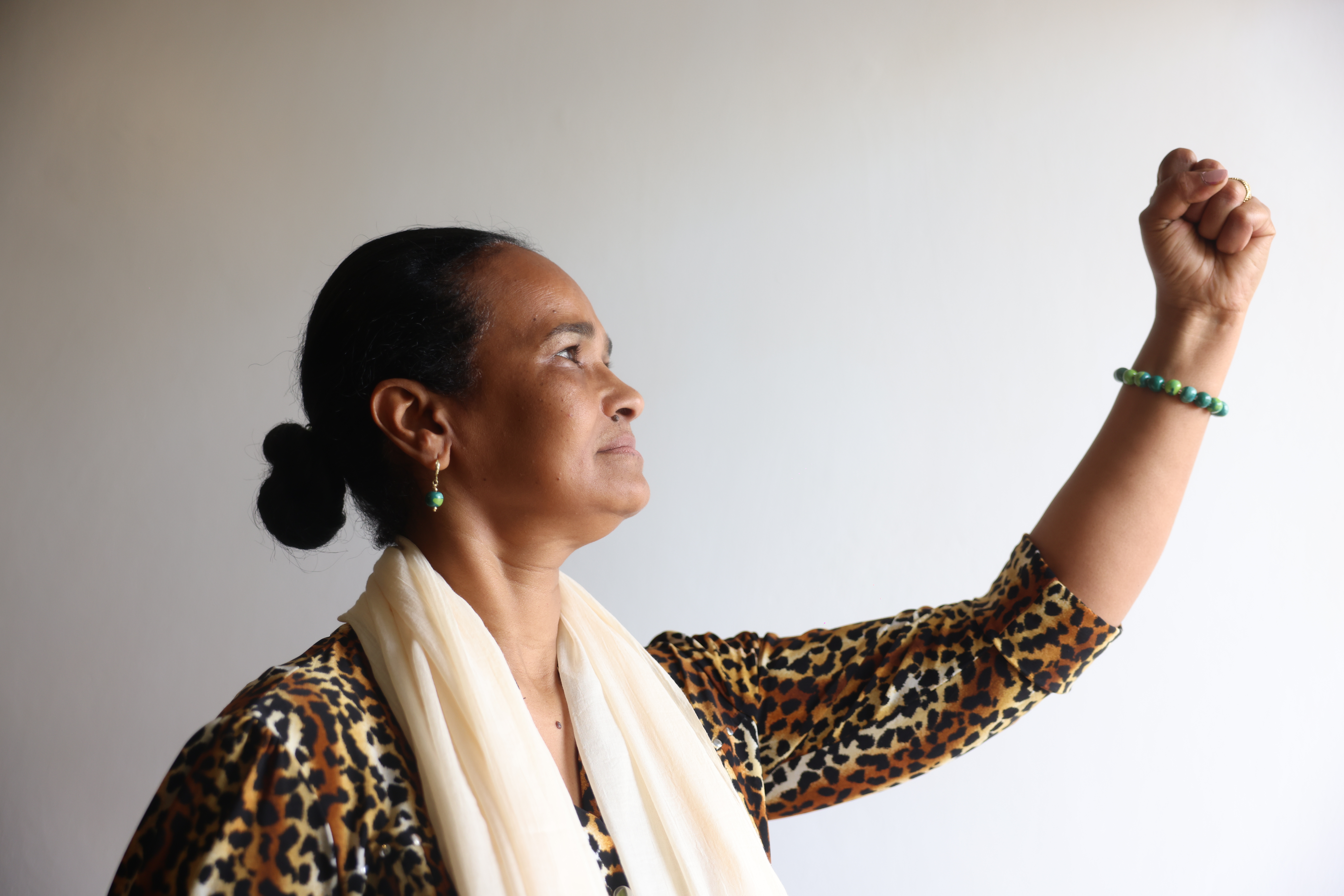
Tahani Abbas Ali fled the war in Sudan with her children in her arms. She tells of women who carried mothers, children and the elderly on their backs for days to reach safety. From exile, she continues their fight — against human rights violations, and for women’s seat at the peace negotiating table.
Tahani nods toward the two mobile phones lying on the table in front of her. One she uses to stay in contact with women inside Sudan. The other connects her to women in refugee camps in neighbouring countries. Between them, she is part of more than 550 WhatsApp groups.
The messages never stop. From Darfur and the Al Jazeira regions, from refugee camps in Chad and Ethiopia, from women on the move and women still living in the middle of the war. Tahani reads everything.
“This is my life. Hour by hour, minute by minute, I try to understand what is happening inside Sudan. I follow, I share information, and I raise the voices of Sudanese women — in meetings online and face to face. I am always trying to catch what is happening inside Sudan.”
Today, Tahani lives in exile in Kenya. She is a lawyer, human rights defender and founder of the Nora Organization for Combating Violence Against Women and Girls.
She grew up in a small village in central Sudan, east of the Al Jazeira region, where education for girls is far from guaranteed.
“I was fighting to go to school. I was fighting to go to university,” she says.
When she arrived in Khartoum in 2000, she experienced the capital for the first time.
“That was when I found myself. I saw how Sudanese women were fighting for their rights, how they stood up against the dictatorship under al-Bashir, and later against the military coup. I began to understand the power of Sudanese women.”
“Even in war, women take on great responsibility — as caregivers, mediators and peacebuilders.”
When the war broke out
On the morning of April 15, 2023, Tahani was preparing to go to Khartoum University. She was due to give a lecture on human rights to young female law students. Then her sister called from New York and told her she had seen fighting break out in Khartoum on social media and on television.
Tahani stepped out onto the balcony.
“I saw only darkness. Then I heard the shooting. From the balcony I could see RSF soldiers closing the streets below.”
The family moved downstairs to a neighbour’s apartment, where they felt slightly safer.
“We had no access to water. This was a war area. We had nothing. The children were afraid, and we did not know what would happen.”
For ten days they stayed while fighting raged around them. Armed men came to the building and placed weapons on the roof.
“They told me: ‘We will bring food, we will bring water.’ But I felt they wanted to keep us there like human shields. The building was high — they wanted to use it. I understood we could not stay.”
The children were hungry. No food came. There were no open shops, and no safe way out.
After ten days, she made her decision, after pressure from friends and family.
“I said: ‘I have only my two children. I have no phone, no passport, nothing. I am leaving my home.’ I had lived there for 15 years.”
Tahani carried her daughter. Her husband carried their son. They walked out into crossfire, with the Sudanese Armed Forces on one side and RSF on the other.
“We held our children like this,” she says, demonstrating with her arms. “If anything happens, let the bullets come into our backs to protect them. We had no option.”
“I did not feel hungry. I did not feel angry. I did not feel anything. I was like a machine. I just moved forward with my children.”
Along the road, among the dead, she saw a woman lying on the ground, uncovered.
“I woke up when I saw this beautiful Sudanese woman. I said to myself: I need to continue my work. This is my duty. This is my responsibility. I must protect her dignity in death.”
“I covered the woman’s body with her traditional Sudanese top, recited from the Quran, and covered her face.”
Organising while fleeing
After walking nearly 95 kilometres on an injured leg, Tahani and her family finally reached Soba in central Sudan, where relatives were waiting.
“I saw my mother, my father and my family. Some were crying, some were happy. I will never forget that moment.”
But she did not stay for long. Reports of sexual violence were already coming in, particularly from Bahri, north of Khartoum. The next day, she travelled on to Madani, where she mobilised doctors, lawyers, journalists and civil society actors.
“We started to receive reports of sexual violence almost immediately. We had experience from Darfur, from the 2019 massacre and from the 2021 coup. We knew sexual violence would be used as a weapon.”
Tahani and her colleagues quickly built a system to receive and document cases, connect survivors with legal and medical support, and reach out to international partners.
“We started to contact the WHO for protocols — to find out how we could intervene. We prepared lawyers, involved journalists, and organised ourselves to receive the cases.”
International organisations and Sudanese groups have documented widespread rape and other forms of sexual violence in Sudan, according to a UN report. The paramilitary Rapid Support Forces (RSF), which is fighting Sudan’s armed forces, is responsible for large-scale sexual violence in areas under its control — including gang rape, abduction and detention of victims.
“Women in Sudan are paying a very high price for their dignity. Our bodies are being used. Women are raped, killed, exploited and forced into sex for food or protection. This is systematic. This is slavery.”
“Survivors of rape are unable to access necessary care to prevent pregnancy and sexual diseases. Even the lady providing voluntary medical support was attacked and raped in an attempt to stop her from helping others,” Tahani explains.
Many women have lost male family members and are left alone to care for children and the elderly. When they flee across borders, they face further abuse.
Yet women are not only victims, she insists.
“In spite of all this mess, you will always find hope. I believe in these women.”
“The women from where I come from carry the elderly on their shoulders. There are no cars. They walk for two or three days to reach safety. They carry their mothers, their fathers, women living with disabilities to save their lives.”
Tahani explains that women who have never been to school are finding way to document violations in their communities.
“They record voice messages to report what is happening in their villages.”
Logistics is power
“After eight or nine months, Madani was taken by RSF. We had to flee for the second time, out of Sudan, to Kenya,” Tahani says.
“Two months after I arrived here, my mother passed away. They did not allow her to reach the hospital. She died on the way, on a cart pulled by a horse, because armed groups were blocking access to healthcare. It happened in Tambool. It’s a small place — there is only one hospital.”
“I still have aunts there. I do not want what happened to my mother, to happen to them. I want to protect those who are still alive.”
“When I look at my children, I think of other people’s children too. I want to protect them as well. We have experience with war — we know what it does to people.”
From Kenya, she travels as much as she can to bring Sudanese women’s voices into international forums and peace processes.
“My passport is full. I had to get a new one. Since the war started, I have travelled many times to the US and Europe to ask: How can you support us? How can you help us find a solution for Sudan?”
At the same time, the very possibility of participating is often blocked by visa barriers. Tahani says that many prominent Sudanese women are invited to international meetings, yet they are still shut out.
“We are suffering from challenges with obtaining visas. You cannot invite Sudanese women and not make it possible for them to come. We need political support to ensure that women are present in the rooms where Sudan is discussed.”
For her, access is about power.
“If Sudanese women are not in those rooms, then our experiences, our demands and our solutions are not there either.”
Women must be part of a peace processes
Alongside her response work, Tahani has pushed for women’s inclusion in peace processes. In Entebbe, Uganda, she supported the organisation of a key dialogue that brought together women from different sides of the conflict — including those affiliated with the Sudanese Armed Forces, the RSF and other armed groups.
“This is the first time women from different sides of the conflict sat in the same room and agreed on a common agenda,” exaplains.
They agreed on four priorities: stop the war, keep Sudan united, ensure women’s political participation, and accountability for atrocities.
“If we have no women at the table of negotiation, our agenda will be absent.”
She insists rural women must also be included.
“I have two eyes. With one I see what is happening in rural areas, and with the other I see what is happening in the centre. I try to bring these voices together.”
No rest
“If you had met me two years ago, you would have noticed know how all my hair has turned grey,” she says, with a brief laugh, before she turns serious again.
“But this is not only me. This is all Sudanese women. They are thinking all the time. They carry fear, responsibility and worry.”
She pauses, then adds:
“People tend to speak about numbers. These are not numbers. This is life — people’s lives, blood, dignity. These are people with history, with belonging, indigenous people living on Sudanese land.”
She rarely rests.
“Sometimes I feel burned out. It is difficult to continue. But when I look at my children, when I look at women and girls in the camps, I say: this is not the time to rest. You must continue.”